
Advanced Temperature-Programmed Oxidation (TPO) of Coked Catalysts Using Integrated Methanation and FID Detection

Comprehensive guide to temperature-programmed oxidation (TPO) of coked catalysts using methanation and FID detection. Technical methodology, parameters & best practices.

Bitmap (77)

Background

Heterogeneous catalysis is integral to a wide array of industrial applications, including energy, chemical synthesis, and consumer products. Traditionally, a solid or powder catalyst is employed to transform gas phase hydrocarbons into valuable products. Elemental carbon deposition onto the catalyst, or "coking," is an undesirable side reaction that, over time, will block the catalytic sites and deactivate the catalyst. Therefore, characterization of carbon deposits is essential for improving catalyst performance.

Today, advanced techniques such as transmission electron microscopy (TEM), laser Raman spectroscopy, electron energy loss spectroscopy (EELS), solid-state ¹³C NMR, and temperature-programmed oxidation (TPO) are widely used to study coked catalysts. Among these, TPO has become one of the most commonly applied methods due to its simplicity and effectiveness.(1)

Temperature-programmed oxidation (TPO) is a materials characterization technique in which the sample is exposed to oxidizing gas, and the oxidizer chemically binds (chemisorbs) onto the surface. As the material temperature is increased, the oxidized surface species desorb from the material and are analyzed by a detector. For coke analysis, the catalyst is heated under O₂ flow, and surface carbon is oxidized to CO₂. The amount of desorbed CO₂ is directly related to the amount of coke, and the temperature at which CO₂ desorbed can differentiate between types of carbon on the catalyst.

Typically, the desorbed product is analyzed by a thermal conductivity detector (TCD) or flame ionization detector (FID), but neither detector is sufficiently sensitive to CO₂. Therefore, a methanation step can be employed to convert CO₂ into CH₄, which is easily measured by a flame ionization detector (FID). This process is shown in Scheme 1.

This AMI Note discusses the use of TPO combined with an innovative detection method developed by Dr. S.C. Fung and Dr. C.A. Querini at Exxon Research and Engineering Company.(2) This approach is straightforward and enables continuous monitoring of the rate of coke oxidation. AMI (Advanced Measurement Instruments) is currently the only company to offer customizable catalyst characterization systems capable of such advanced TPO techniques.

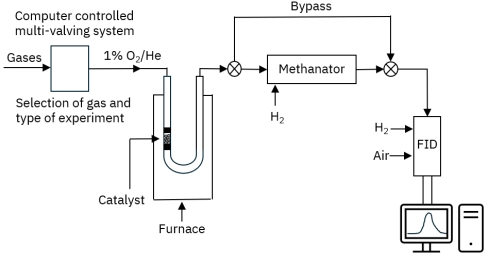
Temperature-programmed oxidation TPO process showing methanation reactor and FID detection for coked catalyst analysis

Scheme 1: Step-by-step process for detection of coke through sequential temperature-programmed oxidation (TPO) and methanation using an AMI catalyst characterization system equipped with a methanator and FID


Bitmap (78)

What is Temperature-Programmed Oxidation (TPO)?

Temperature-programmed oxidation is a powerful materials characterization technique that systematically reveals the oxidation behavior and thermal stability of solid catalyst surfaces. In TPO analysis, a catalyst sample is exposed to a controlled oxidizing gas stream while the reactor temperature is increased linearly—typically at rates between 5 and 20°C per minute—up to target temperatures.

2.1 Key TPO Capabilities for Coked Catalysts

For coked catalysts specifically, TPO operates by heating the catalyst sample under oxygen flow, causing surface carbon to oxidize into measurable products. The resulting carbon oxide gases (primarily CO₂ and CO) provide direct, quantitative information about:
  • Total coke content on the catalyst surface
  • Coke type differentiation through the temperature at which oxidation occurs
  • Coke distribution patterns across the catalyst surface
  • Catalyst regeneration efficiency by monitoring oxidation behavior

Experimental Methods

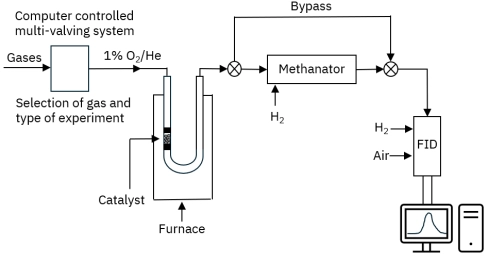
In this TPO method, elemental carbon (coke) on the catalyst surface was oxidized to CO₂ by flowing O₂ through a temperature-controlled flow reactor. However, CO₂ is undetectable by an FID, so the CO₂ was flowed to a methanator and hydrogenated to CH₄. An AMI catalyst characterization system equipped with a methanator and FID was used for these experiments, and Figure 1 shows the system's flow diagram.

Bitmap (78)

Figure 1: System flow diagram for AMI catalyst characterization system equipped with temperature-programmed oxidation (TPO) flow reactor, methanator, and FID


The methanator consisted of a small reactor filled with ruthenium catalyst, positioned downstream of the sample U-tube. When hydrogen passed through the methanator and reacted with CO₂, the Ru catalyst quantitatively hydrogenated CO₂ to CH₄. Therefore, the rate of methane formation was assumed to be equivalent to the rate of coke oxidation. The methane then flowed into the FID, which provided a real-time measurement of the coke oxidation rate. A GC column was unnecessary because the FID is insensitive to oxygen and water vapor in the gas stream.

The experimental details for the sequential TPO and methanation reactions are described in Table 1. Under these conditions, CO₂ was quantitatively converted to CH₄, while the excess oxygen in the carrier gas was reduced to H₂O. The combined gas stream then flowed directly into the FID.

Experimental Parameters

Table 1. Experimental conditions for quantification of catalytic coke by TPO and methanation

ParameterTPO ExperimentMethanation Experiment
Catalyst~20 mg coked catalyst~500 mg 40 wt% Ru/zeolite 13X
Reactant Gas1% O₂/He, 20-80 mL/min flow rate100% H₂, 22 mL/min flow rate
TemperatureTemperature increased linearly until complete oxidation achievedTemperature ranged from 320 °C to 430 °C
 

The Detection Challenge: Why Standard Detectors Fall Short

While TPO methodology is straightforward in principle, a critical limitation has historically constrained its analytical power. The primary oxidation product in TPO experiments is carbon dioxide (CO₂)—a gas for which conventional detectors demonstrate poor sensitivity.

4.1 Limitations of Conventional Detectors
  • Thermal Conductivity Detectors (TCD): While functional, TCDs exhibit relatively low sensitivity to CO₂ and produce noisy baselines that compromise data precision
  • Flame Ionization Detectors (FID): Conventionally designed FID systems are completely insensitive to CO₂ and other fully oxidized carbon compounds—a fundamental limitation of the ionization process
These detection limitations have historically forced researchers to accept lower sensitivity, reduced dynamic range, and less precise quantification of coke oxidation rates.

The Solution: Methanation-Enhanced FID Detection

A breakthrough innovation in TPO detection methodology addresses these limitations through an elegant approach: converting CO₂ into a gas that FID can efficiently detect. This conversion is achieved through a methanation process—a catalytic hydrogenation reaction that transforms CO₂ into methane (CH₄), which FID detectors measure with exceptional sensitivity.

The methanation process operates on a simple chemical principle:

CO₂ + 4H₂ → CH₄ + 2H₂O

This reaction occurs within a specialized methanator unit positioned downstream of the TPO sample reactor. The methanator contains a small reactor bed packed with ruthenium catalyst supported on zeolite (typically 40 wt% Ru/zeolite 13X).

5.1 Advantages of Methanation-Enhanced Detection
  • Superior Detection Sensitivity: FID detectors exhibit extraordinary sensitivity to methane—orders of magnitude greater than their response to CO₂
  • Real-Time, Continuous Monitoring: Dynamic monitoring reveals the kinetic behavior of coke oxidation
  • Simplified System Architecture: No gas chromatography column required
  • Precision in Coke Characterization: Enhanced sensitivity enables detection of carbon concentrations below 0.1%

Influence of Oxygen Concentration, Flow Rate, and Methanator Temperature

Since TPO experiments require an excess of oxygen, it was necessary to evaluate how oxygen concentration in the gas stream affects the methanation of CO₂ to establish optimal operating conditions. The effects of flow rate and methanator temperature on the hydrogenation efficiency of the ruthenium catalyst were also investigated, along with the impact of various pretreatments on the Ru catalyst's activity.

6.1 Oxygen Concentration Effects on CO₂ Conversion

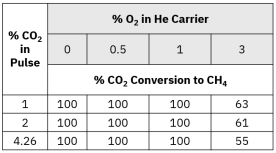
To study the influence of oxygen concentration on CO₂ methanation, pulses of 1%, 2%, and 4.26
% CO₂ in helium were introduced into the methanator using helium carriers containing 0%, 0.5%, 1%, and 3% oxygen.

As shown in Table 2, the CO₂ pulses were completely converted to CH₄ except when the oxygen concentration was increased to 3%.


Bitmap (79)


Table 2. Results showing percent CO₂ conversion to CH₄ at varying pulsed CO₂ and O₂ concentrations

One possible explanation for this behavior is that water formed in the methanator (due to the oxygen present in the carrier gas) reduced the equilibrium conversion of CO₂ to CH₄ (Eqn. 1 and 2).(2)

Equation 1: ½O₂ + H₂ ↔ H₂O
Equation 2: CO₂ + 4H₂ ↔ CH₄ + 2H₂O

Higher oxygen concentrations lead to greater water formation, which in turn affects the equilibrium conversion of CO₂ to CH₄.

TPO experiments should be conducted with oxygen concentrations at or below 3% and at methanator temperatures below 430 °C to avoid equilibrium limitations.

However, the incomplete conversion of CO₂ to CH₄ observed in Tables 2 and 3 may depend on other factors besides equilibrium limitations.

6.2 Flow Rate and Catalyst Activity

An alternative explanation is that water inhibits the methanation activity of the ruthenium catalyst. To investigate this, experiments were conducted varying three parameters: the oxygen concentration in the carrier gas, the methanator temperature, and the carrier gas flow rate.

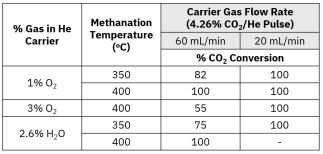
The results are shown in Table 4:

Bitmap (80)

Table 4. Results showing the relationship between carrier gas flow rate and CO₂ conversion at varying O₂/H₂O concentrations and methanation temperatures

At 350 °C, increasing the flow rate of 1% O₂/He to 60 mL/min resulted in 82% CO₂ conversion, while lowering the flow rate to 20 mL/min increased the CO₂ conversion to 100%. At 400 °C the flow rate was no longer limiting, and both 60 mL/min and 20 mL/min rates achieved total CO₂ conversion to CH₄. At higher O₂ concentrations (3% O₂/He), the same trend emerged with only 55% conversion to methane at high flow rates (60 mL/min).

Key Finding: Higher O₂ concentrations require lower flow rates to maintain CO₂ conversion. Higher O₂ concentrations produce more water, and lower flow rates are necessary to reduce the total number of water molecules at a given time.

Experiments were also conducted by introducing water directly into the methanator by saturating the carrier gas at room temperature, producing a 2.6% water concentration in helium. At 350 °C, the CO₂ conversion was largely unaffected by the water presence in the gas stream, showing 100% conversion to methane at lower flow rates (20 mL/min) and 75% conversion to methane at higher flow rates (60 mL/min). At 400 °C, the water-saturated CO₂/He reactant reached 100% conversion even at the higher, less optimal flow rate.

These results confirmed previous findings that oxygen concentrations should ideally remain below 2%. For experiments requiring higher oxygen levels, an oxygen trap can be installed upstream of the methanator. These traps effectively remove oxygen without affecting the CO₂ concentration exiting the sample U-tube.

Temperature-Programmed Methanation Studies

As indicated in Table 4, CO₂ conversion increased with both rising temperature and decreasing flow rate. This behavior suggests that conversion limitations in the presence of oxygen are primarily kinetic in nature. Additionally, the catalyst's activity improved with temperature. However, the methanator temperature should be kept as low as possible to minimize the risk of agglomeration of the ruthenium particles, which would permanently reduce catalyst activity.

Effect of Carrier Gas Flow Rate and Catalyst Stability

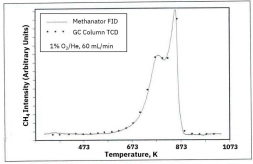
Experimental results indicated that FID sensitivity increased linearly with carrier gas flow rates up to 60 mL/min. At higher flow rates, the FID response plateaued, suggesting that flow rates above this level do not further improve sensitivity.

FID versus TCD detector sensitivity comparison for methane detection in temperature-programmed oxidation analysis


Figure 2: Plot comparing the sensitivity of CH₄ detection for two detectors: FID and TCD

The sensitivity of FID and TCD to methane were compared in Figure 2. While the experimental data overlapped, the FID results were much more precise than the TCD.

8.1 Catalyst Stability and Sulfur Poisoning

An additional important observation was the deactivation of the ruthenium catalyst in the methanator due to sulfur poisoning. This deactivation was caused by sulfur oxides generated during the combustion of sulfur-containing coke deposits. The most effective solution was the installation of a sulfur oxide trap upstream of the methanator, which successfully removed sulfur contaminants without affecting the CO₂ concentration.

Why This Advanced TPO Approach Matters: Applications and Impact

The methanation-enhanced TPO methodology addresses critical research and industrial challenges across multiple sectors:

9.1 Catalyst Development and Optimization

Researchers developing new catalysts require precise quantification of coking behavior under realistic conditions. The enhanced sensitivity of methanation-FID detection enables discrimination between catalysts that differ only subtly in their coke resistance.

9.2 Process Regeneration and Lifecycle Management

Industrial plants operating catalytic reactors must periodically regenerate spent catalysts through controlled oxidation. Advanced TPO characterization reveals the optimal regeneration conditions (temperature, oxygen concentration, duration) that remove carbon deposits while preserving catalyst structure.

9.3 Hydrogen Production and Synthesis Gas Generation

Modern hydrogen production via steam reforming and partial oxidation requires catalysts with exceptional coke resistance, as carbon deposition directly reduces hydrogen yield. TPO analysis using methanation detection provides detailed characterization of coking behavior.

9.4 Environmental and Energy Applications

Development of catalysts for fuel cell applications, diesel oxidation catalysts (DOCs), and emissions control requires understanding how carbon deposition affects active site availability and catalyst performance over extended operation.

Conclusions

These experiments demonstrate that TPO coupled with methanation and FID detection is a highly effective technique for monitoring the carbon oxidation rate of coked catalysts. By optimizing experimental parameters, complete conversion of CO₂ or CO to CH₄ is achievable, even in the presence of oxygen-containing carrier gases.

Key Findings:
  • This method is sensitive enough to detect carbon concentrations below 0.1%
  • Can distinguish subtle variations in the coke distribution on catalyst surfaces
  • Oxygen concentrations should remain at or below 3%
  • Methanator temperatures should stay below 430°C
  • Flow rates up to 60 mL/min provide optimal sensitivity
AMI (Advanced Measurement Instruments) is the only company to offer chemisorption analyzer platforms that can be integrated with an FID detection system and methanation reactor for advanced TPO studies.

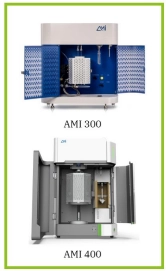
AMI 400 chemisorption analyzer for advanced TPO catalyst characterization

Figure 3: AMI chemisorption analyzers for catalyst characterization

The AMI 300 and AMI 400 Series chemisorption analyzers, shown in Figure 3, are designed for customizability. AMI chemisorption analyzers can easily be fitted with a methanator/FID module at the customer's request. This unique configuration enables precise, real-time quantification of coke oxidation rates with unparalleled sensitivity.

This AMI Note summarizes a presentation delivered by Dr. S.C. Fung at an AMI (formally Altamira) U.S. User's Meeting. For further details on this TPO methodology, see reference (2).

Related Technical Resources

For deeper exploration of temperature-programmed techniques and catalyst characterization methodology, refer to foundational research by Fung and Querini (1992), which established the theoretical basis for this detection approach.

Additional technical guidance on temperature-programmed reduction (TPR) parameters and profiles provides complementary insights into catalyst characterization protocols.

Organizations implementing these techniques should consult AMI chemisorption analyzer specifications for equipment configuration details, and explore the complete chemisorption product category to identify the optimal analytical platform for their specific research requirements.

References

(1) Querini, C. A. and Fung, S. C. Coke characterization by temperature programmed techniques. Catal. Today, 1997, 37, 277-283.

(2) Fung, S. C. and Querini, C. A. A highly sensitive detection method for temperature programmed oxidation of coke deposits: Methanation of CO₂ in the presence of O₂. J. Catal. 1992, 138, 240-254.

Send Us A Message

Frequently Asked Questions

Temperature-programmed oxidation (TPO) is a catalyst characterization technique in which a coked catalyst is heated under a controlled oxygen flow to oxidize deposited carbon into CO₂. By monitoring the evolved gases as temperature increases, TPO quantifies total coke content and differentiates carbon species based on oxidation temperature, providing insight into catalyst deactivation and regeneration behavior.

Methanation is used because flame ionization detectors (FID) are insensitive to CO₂, the primary oxidation product in TPO. In the methanator, CO₂ reacts with hydrogen over a ruthenium catalyst to form methane (CH₄), which FID detects with extremely high sensitivity. This conversion significantly enhances detection limits and enables precise, real-time monitoring of coke oxidation rates.

For reliable CO₂ conversion and accurate quantification, oxygen concentration should remain at or below 3% (ideally below 2%), methanator temperature should stay under 430°C, and carrier gas flow rates should not exceed 60 mL/min. These conditions ensure complete CO₂-to-CH₄ conversion while preventing equilibrium limitations and catalyst deactivation.

Higher oxygen concentrations increase water formation during methanation, which can shift reaction equilibrium and reduce CO₂ conversion efficiency. Elevated oxygen levels may also inhibit ruthenium catalyst activity. To maintain quantitative methane formation, lower oxygen concentrations and optimized flow rates are recommended, or an oxygen trap can be installed upstream of the methanator.

Methanation-enhanced FID detection offers significantly higher sensitivity and better signal precision compared to thermal conductivity detectors (TCD). It enables detection of carbon concentrations below 0.1%, provides real-time monitoring without requiring a GC column, and allows accurate differentiation of coke oxidation behavior—making it ideal for advanced catalyst research and industrial regeneration studies.
Other Technical Libraries