Learn how the Densi 100 True Density Analyzer is used to measure the true density of ceramic fracturing proppants. Ensure the quality of your proppants with AMI.[…]

Learn how differential scanning calorimetry (DSC) is used to analyze the thermal properties of lipstick. See how the AMI DSC 600 can help you develop high-quality cosmetics.
Lipstick is a common cosmetic product that has remained popular among a wide range of consumer demographics. Considering the highly competitive cosmetics market, successful lipstick products should be formulated to achieve certain standards which have become expected by the customer. Effective formulas typically deliver softness, non-toxicity, elasticity, uniformity in color and texture, and longevity.⁽¹⁾ Although different lipsticks vary significantly in texture and color, their main components can be generally divided into eight categories: oils (30-50%), waxes (10-25%), butters (10-15%), fillers and texturizers (8-12%), pigments (5-20%), other additives (1-5%), fragrances (1-2%), and preservatives (1%).(1)The melting temperature of all these components can vary significantly, and lip products must also meet specific thermal requirements such as: ✓ Softening at surface body temperature (35°C), and; ✓ Remaining solid at room temperature (25°C). Due to the different melting temperatures of each component, lipstick is prone to oil seepage (commonly known as "sweating") due to softening of the paste in a high-temperature environment. Therefore, heat resistance has become one of the key performance indicators to measure the quality of lipstick.⁽¹⁾ The performance of lipsticks is closely related to the melting behavior of their components and the thermal transition temperature of the overall formulation. By accurately measuring these thermal transitions, differential scanning calorimetry (DSC) has become an indispensable key testing method in the cosmetic industry for lipstick development and quality control.⁽²⁾
Five different lipsticks (labeled A-E) were selected as samples and tested using AMI's DSC 600 differential scanning calorimeter. Approximately 15 mg of sample was cut from each lipstick paste, placed in a sealed aluminum crucible, and capped. The experiment was conducted in an inert N₂ atmosphere with a heating rate of 10 oC/min and a temperature range of -90 oC to 140 oC to encompass the melting point range of major components.
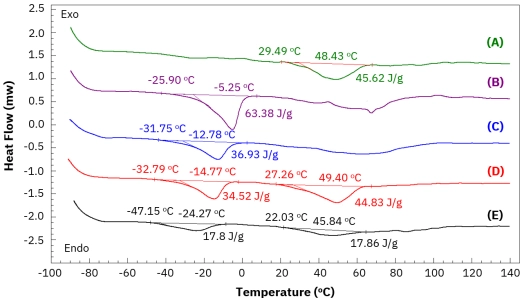
The DSC results are shown in Figure 1 and Table 1, which show that all five lipsticks have multiple endothermic peaks in the low temperature range of -90 oC to 140 oC. Among them, the melting peaks in the low temperature region (below 0 oC) may derive from the low-melting oil components of some liquid oils or esters. The melting peaks in the range of 40-70 oC are likely waxy components with relatively low melting points compared to commonly used waxes like beeswax (Tm ~ 65 oC) or polyethylene (Tm ~ 90 oC).(1)

Figure 1: DSC thermograms for lipsticks A (green), B (purple), C (blue), D (red), and E (black)
| Lipstick | Peak 1 Temp (°C) | Peak 1 Enthalpy (J/g) | Peak 2 Temp (°C) | Peak 2 Enthalpy (J/g) |
|---|---|---|---|---|
| A | 48.43 | 68.13 | – | – |
| B | -5.25 | 63.38 | 40-80 (multiple) | – |
| C | -12.78 | 55.21 | 40-80 (broad) | – |
| D | -14.77 | 34.52 | 49.40 | 44.83 |
| E | -24.27 | 23.15 | 45.84 | 39.23 |
Table 1: Results from DSC thermograms for lipsticks A-E The DSC curve of lipstick A (Fig. 1, green curve) shows only one melting peak, indicating that the formula mainly consists of a single base ingredient. This endothermic peak, likely corresponding to its main structural component (such as wax or silicon-based materials), is located at 48.43oC. The melting point is higher than room temperature, but still close to the body temperature (35 oC) and ambient summer temperatures, depending on the region. Therefore, it has poor high temperature and heat resistance but adequate spreadability. The melting peak of lipstick B (Fig. 1, purple curve) at -5.25 oC was sharp, and the enthalpy value was high at 63.38 J/g. This indicates that lipstick B has a significant amount of oil components, which are easier to apply but more likely to “sweat” in summer. However, small melting peaks in the range of 40 to 80°C can also be observed for lipstick B, which indicates that a small amount of higher melting point wax was added to the formulation to enhance heat resistance. While this added wax may improve thermal properties, the addition of high melting point wax also increases the hardness of the paste. Lipstick C (Fig. 1, blue curve) was primarily oil-based (Tm = -12.78 oC) but also contained a weak, broad peak between 40 and 80 oC, which may indicate a small amount of wax added to the oil-based formula. With only a small amount of hard wax added, this formula may exhibit a balance between heat resistance and softness. Lipstick D (Fig. 1, red curve) displayed two melting peaks (-14.77 oC, 49.40 oC) with similar enthalpy changes (34.52 J/g, 44.83 J/g) indicating roughly equivalent oil and wax components. This gave the lipstick good high temperature stability, but the high wax content could lead to the paste being hard. Lipstick E (Fig. 1, black curve) shows a wide and short melting peak at -24.27 oC in the low temperature region, indicating the existence of a multi-component eutectic system, which may be a mixture of silicone oil and alkanes. At the same time, the melting peak is observed in the higher temperature area with a peak of 45.84 oC, indicating that lipstick contains waxy components that can maintain a solid state at room temperature but have a relatively low melting point, which means that it is easy to soften at high temperatures but has insufficient heat resistance.
The melting temperature and enthalpy value of each component measured by the DSC curve are the key thermal performance indicators for evaluating the high-temperature stability and low-temperature spreadability of lipsticks. Analysis by differential scanning calorimetry (DSC) using the AMI DSC 600 can clearly reveal the differences in the melting properties of their components. The DSC 600 offers high sensitivity and user-friendly software at an accessible price.
2: Highlight of DSC 600 by AMI
For more information on our thermal analysis instruments, please contact us. You can also explore our full range of products or browse our technical library for more application notes.
(1) Rigano, L. and Montoli, M. Strategy for the development of a new lipstick formula. Cosmetics, 2021, 8, 105.(2) Pan, S. and Germann N. Thermal and mechanical properties of industrial benchmark lipstick prototypes. Thermochim. Acta, 2019, 679, 17833Differential Scanning Calorimetry (DSC) is essential in lipstick formulation because it accurately measures melting temperatures and enthalpy changes of individual components within the product. These thermal transitions determine key performance attributes such as heat resistance, spreadability, hardness, and stability. By analyzing DSC curves, formulators can optimize the balance between oils and waxes to ensure the lipstick remains solid at room temperature while softening appropriately at body temperature.
Multiple melting peaks in a DSC thermogram indicate the presence of different components with distinct melting temperatures. In lipsticks, low-temperature peaks typically correspond to oils or esters, while peaks in the 40–70°C range are usually associated with waxes. The number, position, and enthalpy of these peaks help determine the ratio of oils to waxes and predict the product’s softness, hardness, and heat resistance.
Lipstick “sweating” occurs when oil components soften or separate under high temperatures. DSC identifies low-melting oil fractions and evaluates the strength of wax structures within the formula. By adjusting the proportion of high-melting-point waxes based on DSC data, manufacturers can improve structural stability and reduce the risk of oil seepage during storage or summer conditions.
A high-quality lipstick should:
Remain solid at room temperature (around 25°C)
Soften smoothly at surface body temperature (around 35°C)
Maintain structural integrity at elevated temperatures
DSC provides precise measurements of melting temperature and enthalpy, which serve as key indicators of high-temperature stability, mechanical strength, and application performance.
The AMI DSC 600 provides high sensitivity, precise temperature control, and reliable detection of multiple thermal transitions in complex cosmetic formulations. Its wide temperature range (-90°C to 140°C) allows comprehensive analysis of both low-melting oils and high-melting waxes. Combined with user-friendly software and cost-effective operation, it is a valuable tool for cosmetic R&D and quality control laboratories.

Learn how the Densi 100 True Density Analyzer is used to measure the true density of ceramic fracturing proppants. Ensure the quality of your proppants with AMI.[…]

Learn about pulse chemisorption, a technique for characterizing catalysts and measuring metal surface area. Discover how AMI’s instruments can help you.[…]

Discover how specific surface area and pore structure affect the performance of potassium-ion batteries. Learn how AMI’s instruments can advance your battery research.[…]

Understanding TPD kinetics, surface characterization, and desorption dynamics for heterogeneous catalyst analysis.[…]