Learn how the Densi 100 True Density Analyzer is used to measure the true density of ceramic fracturing proppants. Ensure the quality of your proppants with AMI.[…]

Potassium-ion batteries (PIBs) are considered an important complement to existing lithium-ion batteries (LIBs) due to their environmental friendliness, abundant raw material resources, and low cost. PIB anode materials have become the focus of research, and carbon-based anodes have been studied for their high conductivity and chemical stability.

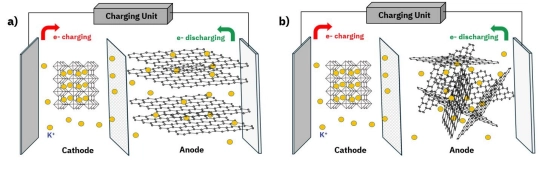
Graphite has been heavily studied for PIBs due to its theoretical storage capacity for K+ ions and therefore high energy density, shown schematically in Figure 1a. However, there are several limitations. The K+ ion has low mobility in graphite channels and pores due to its large ionic radius.⁽¹⁾ Many scholars have improved the performance of carbon materials in PIBs by surface modification, structural design, and functionalization.⁽¹˒²⁾

While graphite modification has been shown to improve K+ ion intercalation/deintercalation, attempts to increase the interlayer spacing often introduce defects into the material which reduce performance and stability. Alternatively, hard carbon is an amorphous material with randomly oriented sp2 planes. The disordered structure results in inherently larger spacing that facilitates faster intercalation and deintercalation of K+ ions. Because of this, hard carbon anodes have demonstrated excellent cycling stability when paired with an appropriate electrolyte.⁽³⁾ The optimization of cathodic material properties plays an integral role in PIB chemistry, and therefore surface area and pore size have received attention from scholars.⁽⁴⁾

Porous carbon materials have also emerged as promising anode materials for potassium-ion batteries due to their high specific surface area, excellent conductivity, and structural stability. Quan et al. prepared porous carbon materials with different pore structures, investigating the influence of pore volume on the performance of potassium-ion batteries. They found that larger mesopore volumes increased adsorption capacity and improved cycling stability.⁽⁵⁾
Figure 1: Working principle of potassium-ion batteries with a) graphite anode and b) hard carbon anode.
Large specific surface areas for potassium-ion battery anodes enhance the reaction efficiency between K+ ions in the electrolyte and the electrode, facilitating the faster formation of a solid electrolyte interphase (SEI) film on the anode. This helps to minimize electrolyte ion loss. Meanwhile, a larger pore volume provides higher capacity for potassium ion storage within the pore channels of the anode material, improving its charge-discharge capacity.

From Figure 2, the adsorption-desorption curves obtained using N₂ at 77 K reveal that the Hard Carbon B sample exhibited more pronounced microporous characteristics compared to the Hard Carbon A sample, highlighted by a red oval in Figure 2a. Calculations show that the specific surface area of the Hard Carbon B sample (39.515 m²/g) was significantly larger than Hard Carbon A (2.953 m²/g). The differential pore size distribution plots are pictured in Figure 2b, which shows that Hard Carbon B had a higher number of pores with an average diameter below 1nm (ultramicropores). The total pore volume and micropore volume of Hard Carbon B (0.041 cm³/g and 0.016 cm³/g, respectively) were also greater than the total pore volume of Hard Carbon A (0.0087 cm³/g).
Figure 2: a) N₂ adsorption-desorption isotherm at 77K and b) differential pore size distribution plots for Hard Carbon A (black line) and Hard Carbon B (red line).
Figure 3: a) CO₂ adsorption-desorption isotherm at 273K and b) differential pore size distribution plots for Hard Carbon C (black line) and Hard Carbon D (red line).
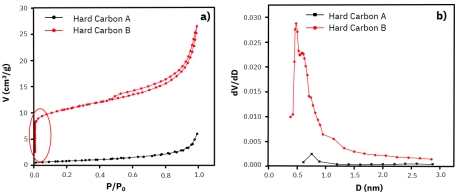
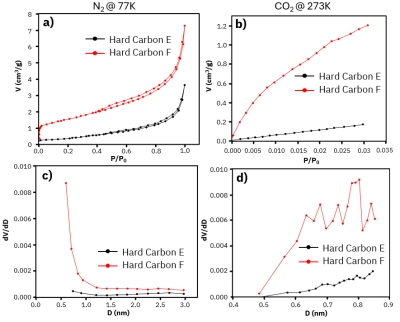
Figure 4: a) N₂ adsorption-desorption isotherm at 77K, b) CO₂ adsorption-desorption isotherm at 273K, c) differential pore size distribution plots using N₂, and d) differential pore size distribution plots using CO₂ for Hard Carbon E (black line) and Hard Carbon F (red line).
The specific surface area and pore volume of hard carbon materials can also be analyzed through CO₂ gas adsorption. As shown in Figure 3, two types of hard carbon materials prepared by a university research group were tested. The CO₂-probed specific surface area of Hard Carbon C reached 137.1 m²/g, with a micropore size of approximately 1.368 nm and a pore volume of 0.113 cm³/g, significantly surpassing the specific surface area and pore volume of Hard Carbon D.

At a temperature of 273 K, the CO₂ pressure required for micropore size analysis falls within a moderate range (~0.1 to 100 kPa), and the diffusion rate of CO₂ is faster than N₂. Figure 4 compares the adsorption isotherms using N₂ and CO₂ for Hard Carbon E and F. It is evident that while the adsorption capacity and behavior trends were similar for both gases, CO₂ at 273 K was able to characterize smaller-sized pores more effectively at low P/P₀ values (Figure 4b). For pore size and volume analysis, CO₂ provided greater precision (Figure 4d). The changes in pore size and volume brought about by micropores are closely related to the total embedding capacity of K+ ions in the anode adsorption on the anode surface in actual battery systems. Superior pore structures positively impact Coulombic efficiency, charge-discharge efficiency, and battery lifespan.
In this application note, gas adsorption experiments using the AMI Micro 200, shown in Figure 5, demonstrated broad variations in the porosity of carbon battery materials. The use of N₂ adsorbate was compared to CO₂ adsorbate, and it was shown that CO₂ adsorbate was ideal for characterizing small micropores. The AMI Micro 200 is a high-precision instrument designed for the accurate determination of material properties important for battery research, such as specific surface area and pore size of electrodes.
For more information on our physisorption instruments, please contact us. You can also explore our full range of products or browse our technical library for more application notes.